

As the lead technologist for Tempest, a next-generation combat aircraft, Andrew Batty is using his Human Factors expertise to design its cockpit.
Andrew Batty is the Human Factors Research and Technology Lead for BAE Systems Air Sector.
As a human factors specialist, he studies how people interact with their working environment – in his case that’s an aircraft and the systems that support it, whether in a cockpit or on the ground.
Currently Andrew is researching new technologies that could be integrated into the cockpit to make the role of the pilot even more intuitive and effective, while not overloading them with tasks and information.
His team does a lot of research and development in this area, working with universities and other companies to stay on top of new technologies, then test the ones that could enhance human performance.
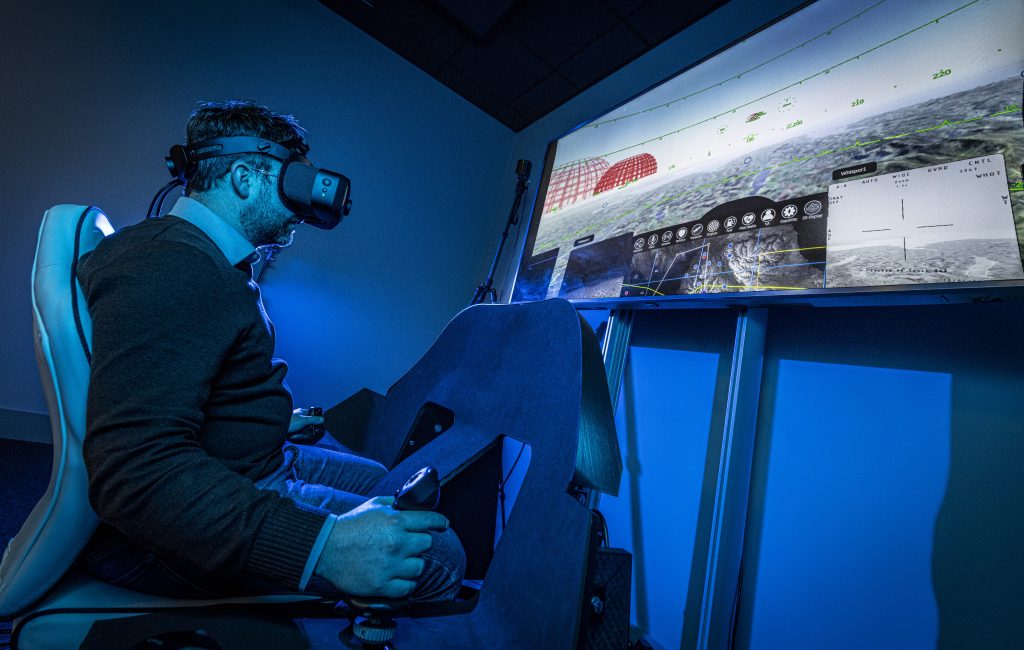
Before joining the Human Factors team, Andrew has also worked on projects such as researching mission management aids for Typhoon and F-35 interoperability, and aircraft carrier trials.
Andrew describes his current role as a fascinating blend of psychology and engineering. Starting his career with a degree in aviation technology, he then trained as a commercial pilot. He joined BAE Systems as a procurement graduate in 2011 before finding his way into the world of Human Factors where his love of engineering and interest in psychology combined.
Andrew brings invaluable experience to the team as a pilot. He said “During pilot training, you spend a lot of time looking at things that have gone wrong in the past. It’s interesting to see how human behaviour can either save the situation or make things worse.
“That’s where my human factors interest came from. In my role I get to look at pilot interfaces right before design even starts, so think about how to make the aircraft a seamless extension of the pilot.
“The demands on military aircraft pilots are extraordinary. As well as flying the plane, they also manage all of the weapon and mission systems while staying fully aware of their environment.”
In his current role Andrew and the team are using psychophysiological monitoring to get an objective measurement of pilot workload. The measures include using include galvanic skin response, heart rate, respiration, eye tracking and EEG (electroencephalograms) for monitoring brain activity. The team explore how these measuring technologies can be integrated into pilot clothing and equipment to make the role even more intuitive and effective for the pilot.
Andrew added “I’m working with some great people too, including Dr Yashar Moshfeghi, who specialises in machine learning at the University of Strathclyde. We’re developing algorithms and applying machine learning to correlate these measurements with pilot workload, which is a really interesting process.
“Every person reacts differently, so we’ve actually found that you get better results by personalising the algorithms to the individuals involved, particularly in the EEG results, but there are also some more general measurements that apply to most people.”
Whilst much of Andrew’s focus is on the development of Tempest, the technologies could have applications beyond that. The team are always thinking about other uses such as for wider training, as analysing objective workload data from people is a really useful tool for identifying where they need further development.




